$$ \usepackage{amssymb} \newcommand{\N}{\mathbb{N}} \newcommand{\C}{\mathbb{C}} \newcommand{\R}{\mathbb{R}} \newcommand{\Z}{\mathbb{Z}} \newcommand{\ZZ}{\ooalign{Z\cr\hidewidth\kern0.1em\raisebox{-0.5ex}{Z}\hidewidth\cr}} \newcommand{\colim}{\text{colim}} \newcommand{\weaktopo}{\tau_\text{weak}} \newcommand{\strongtopo}{\tau_\text{strong}} \newcommand{\normtopo}{\tau_\text{norm}} \newcommand{\green}[1]{\textcolor{ForestGreen}{#1}} \newcommand{\red}[1]{\textcolor{red}{#1}} \newcommand{\blue}[1]{\textcolor{blue}{#1}} \newcommand{\orange}[1]{\textcolor{orange}{#1}} \newcommand{\tr}{\text{tr}} \newcommand{\id}{\text{id}} \newcommand{\im}{\text{im}\>} \newcommand{\res}{\text{res}} \newcommand{\TopTwo}{\underline{\text{Top}^{(2)}}} \newcommand{\CW}[1]{\underline{#1\text{-CW}}} \newcommand{\ZZ}{% \ooalign{Z\cr\hidewidth\raisebox{-0.5ex}{Z}\hidewidth\cr}% } % specific for this document \newcommand{\cellOne}{\textcolor{green}{1}} \newcommand{\cellTwo}{\textcolor{red}{2}} \newcommand{\cellThree}{\textcolor{brown}{3}} \newcommand{\cellFour}{\textcolor{YellowOrange}{4}} $$

Commutator subgroups, derived series and their geometric interpretation

algebra
group theory
Author

Luca Leon Happel

Published

February 8, 2026

Given a group \(G\), the commutator \([G,G]\) is defined as

\[ \begin{align*} \text{span} \{ [g,h] \} = \text{span} \{ ghg^{-1}h^{-1} \} \end{align*} \]

Let us consider \(G\) as a “space” of a videogame, in which a player may move around in. The players position is then given by an element \(p \in G\). Assume that \(G\) is finitely generated by a set of generators \(S\). Then the player can move around in \(G\) by applying the generators to their position. For example, if \(s \in S\) is a generator, then the player can move from position \(p\) to position \(ps\). I have visualized this idea previously on my Instagram account: https://www.instagram.com/stories/highlights/17907335377797682/

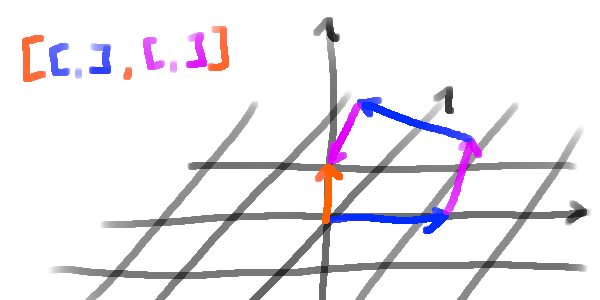
It might so happen that when a player moves in a circle, that he does not end up at the place location at which he started:
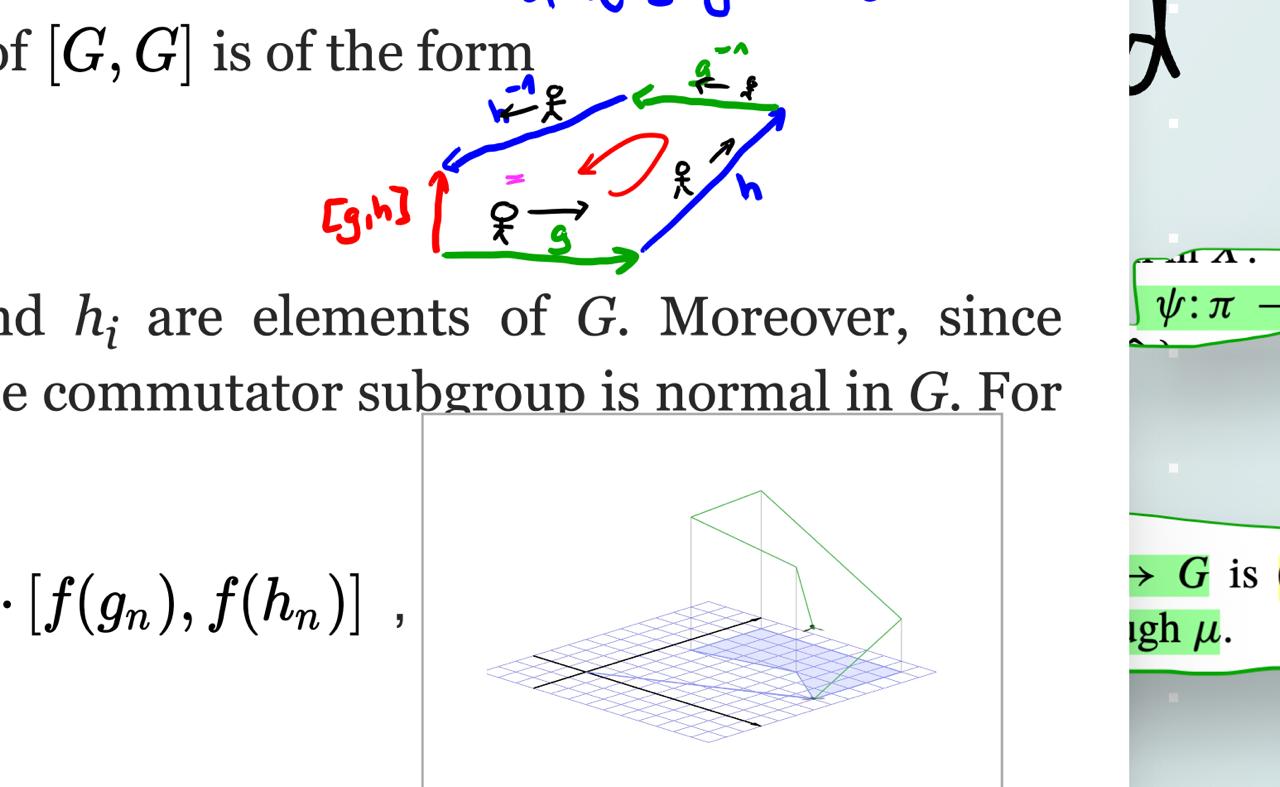
player walks in circle

The commutator subgroup detects all these displacements (here shown in blue):
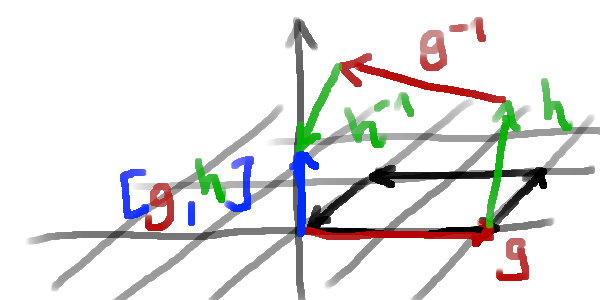
commutator subgroup

We can iterate this process and look at the commutator of the commutator, and so on. This gives us the derived series of a group:

\[ \begin{align*} G^{(0)} &= G \\ G^{(1)} &= [G,G] \\ G^{(2)} &= [G^{(1)}, G^{(1)}] \ &\vdots \end{align*} \]

Which we can also visualize as follows:
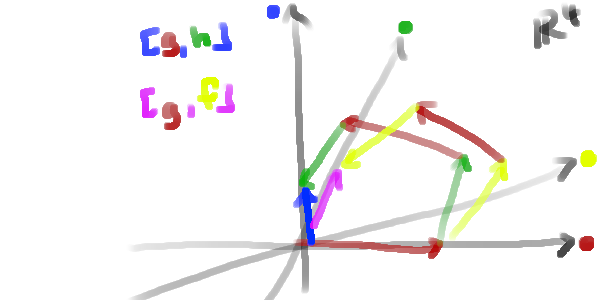
first commutator in derived series

second commutator group in derived series

I am unsure if this is actually deeply connected or not, but I came across this idea while watching this YouTube video by Zeno Rogue: